
Chapter Nine: 2009
By the time the next recurrence came due, Helen Mercer had spent seventeen years preparing for it in a way neither Walter Nash nor anyone before him had ever had the tools to manage. The internet had, by 2009, made the kind of research that once took Walter months of letters and library requests possible in an afternoon, regional papers searchable from her own desk, small-town event calendars indexed and cross-referenced without a single stamp or long-distance call required. Helen had, in the years since Walter's death, built a standing search she ran every week without fail, watching for a small, specific cluster of words she had long since memorized without needing to check her own notes: Grinwick. Last Carnival. One night only.
She found it in early September, nearly three full weeks before the closing show it announced, the earliest warning anyone keeping this particular watch had ever managed to secure.
The location, when she finally confirmed it, took the breath out of her more thoroughly than either of the two prior recurrences had.
Colter's Crossing was not, by any formal measure, a town at all, a crossroads community of perhaps four hundred people, a gas station, a volunteer fire hall, and a scattering of farms, sitting just inside the neighboring county line, close enough to Richmond that its own water tower was visible, on a clear day, from the second floor of the Richmond library where Helen had spent nearly four decades of her working life. Twelve miles. A fifteen-minute drive on the back roads that half of Richmond used without a second thought whenever they needed the Colter's Crossing gas station or the diner beside it.
Helen did the arithmetic that night the same way Walter once had, pin after pin, moving inward, until this fifth pin landed close enough to Richmond's own edge that there was, for the first time in the whole history of her and Walter's map, no meaningful distance left to measure.
She did not go alone this time.
Helen had, in the years since Walter's death, quietly begun the same work he had once done with her, identifying someone Richmond could trust to carry this forward, should anything ever happen to her before the pattern resolved. She had settled, by 2009, on a man named Daniel Ruiz, thirty-four years old, a volunteer firefighter and paramedic whose own grandfather had been one of the young men who'd fought the original blaze back in 1958, a connection Helen had not gone looking for specifically, but which had struck her, when she learned of it, as too fitting to set aside. Daniel had grown up hearing fragments of his grandfather's account of that night, enough that when Helen finally sat him down and told him the fuller story, he did not react with the disbelief she had braced herself for. He reacted, instead, with the particular grim, practical calm of a man whose entire training was built around walking toward emergencies other people ran from.
They drove to Colter's Crossing together on the Wednesday of that final week, and again, Helen insisting on this, over Daniel's objections, with the same hard-won caution Walter had once tried and failed to instill in her, kept themselves apart from each other in the crowd, watching rather than engaging, gathering what they could without drawing any attention they didn't need.
What Helen observed that Wednesday matched, in every particular, what she had already documented in Millhaven seventeen years before, the same five performers, unaged, unmistakable to anyone who had read as deeply into this as she had. What was new, and what occupied the greater part of her attention that evening, was the platform.
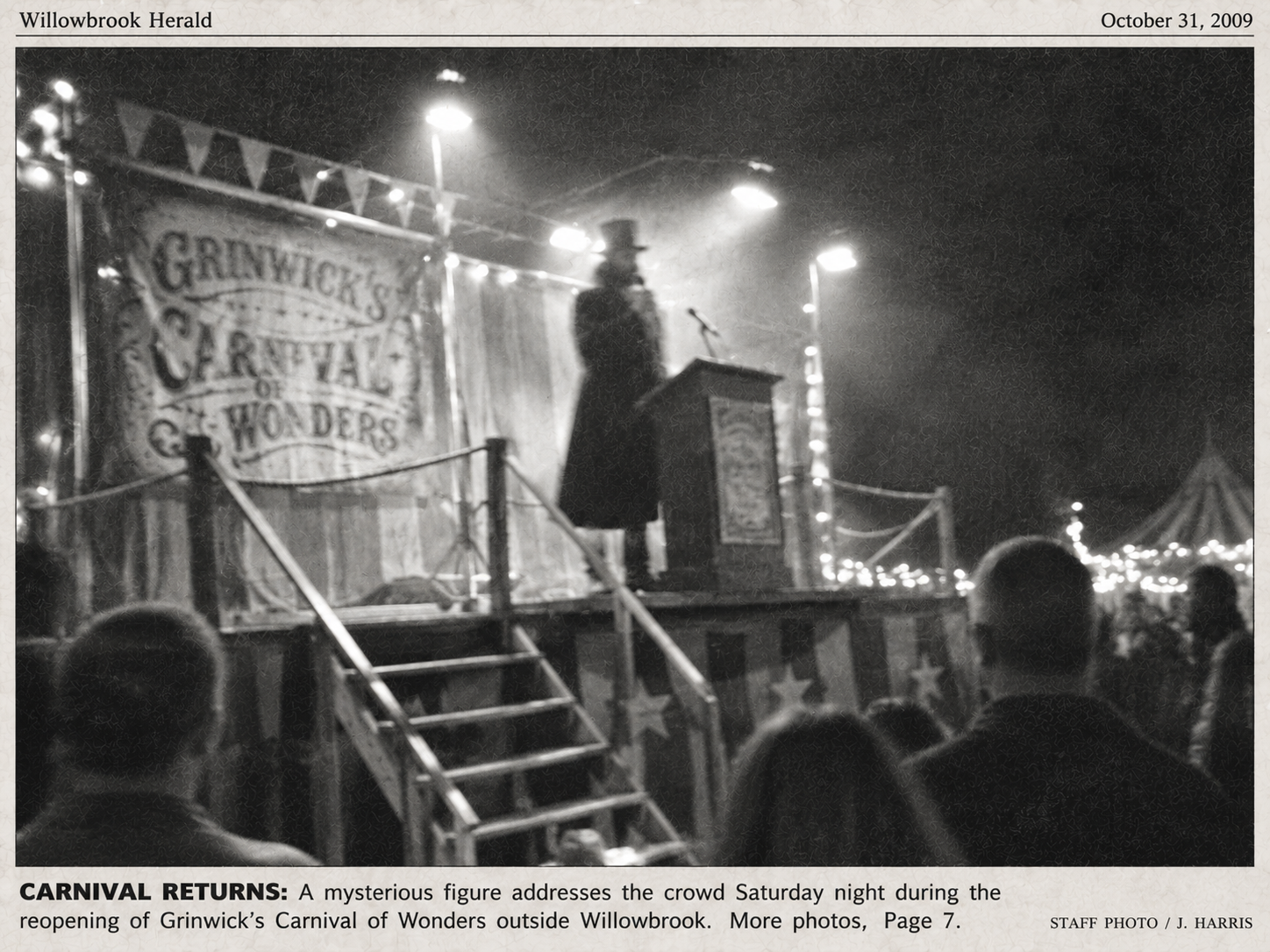
Grinwick himself, she used the name freely now, in her own notes, the way one uses the name of any long-known adversary, held court that night from an elevated stage near the fairground's center, raised well above the crowd, cane in hand, narrating the evening's acts with the same magnetic, unhurried showmanship every witness across every decade had described. He did not descend. He did not, so far as Helen or Daniel could determine across three separate hours of careful observation, ever leave that platform at all.
It was Daniel who first noticed what sat behind him on it, a small wooden lectern, positioned just at the platform's rear edge, holding what appeared, from the distance they were keeping, to be an old, leather-bound ledger, its pages visibly foxed and uneven, several corners torn away entirely.
That's it, isn't it, Daniel said quietly, when he found Helen again near the gate afterward. That's the contract Walter wrote about.
Helen didn't answer immediately. She had spent seventeen years reading every word Walter had ever written about that torn, scattered document, and she recognized, in the shape of that ledger even from a distance, something her own decades of research had never let her hope she might actually see with her own eyes.
What Helen and Daniel did next is the single most debated decision in the entire archive of this story, debated not by outsiders, who have never known enough to debate it, but privately, carefully, among the small handful of keepers who have inherited the full record since. Helen herself, in her own later notes, never fully resolved whether she believed it had been the right choice. She recorded it plainly, without either defending it or apologizing for it, and left the judgment to whoever came after her.
On the final night, Saturday, the closing show, the crowd at its fullest and Grinwick at the height of his performance, every eye in Colter's Crossing fixed on the platform where he held them, Daniel Ruiz worked his way, slowly and without drawing notice, around the rear of the fairground toward the base of that raised stage, while Helen remained near the front, watching the crowd for any sign of the disappearances she knew, with sick certainty, were already beginning to happen somewhere out of sight.
Daniel would tell Helen, afterward, that he had gone with no clearer plan than to see how close he could get, that the decision to actually reach up, in the platform's one unguarded moment, and tear a single loose, already-detached corner of yellowed paper free from where it had slipped half out of that ledger's binding, was not a plan at all so much as an instinct he acted on before he had fully finished thinking it through.
What he would not fully describe, in any account he ever gave afterward, was the half-second in which Grinwick's attention, mid-sentence, mid-performance, addressing a crowd of several hundred people who had no idea anything behind their Ringmaster had moved at all, turned, entirely and precisely, toward the one man in Colter's Crossing who was not currently watching the show.
Daniel got clear. He has always insisted on that point specifically, in every retelling: he got clear, he found Helen, they left together, and neither of them, in the confusion and grief and quiet horror of the following week, was ever counted among Colter's Crossing's missing.
But he would say, years later, to the one or two people ever trusted with the fuller account, that Grinwick's voice had followed him, not loudly, not in any way the rest of the crowd seemed to notice at all, but close, somehow, close enough to feel pitched directly and only for him, in the same warm, familiar register Walter Nash had once described hearing across sixty feet of empty field.
Keep it safe, then, the voice had said, with what Daniel swore, however impossible it sounds, was something close to amusement rather than anger. It'll only mean we have to come back for it eventually. I don't mind waiting. I've had a great deal of practice.
Colter's Crossing lost seven people that October, the worst single-night count in any recurrence Helen had yet documented, a fact she has never been able to fully separate, in her own private reckoning, from what she and Daniel did on that platform. She has written, more than once, that she does not know whether taking that fragment cost more lives than it saved, prevented, or had no bearing on at all, that the arithmetic of it is not one she has ever found a way to make come out clean, however many times she has tried.
What she does know, what she recorded, carefully, in the months that followed, as she watched for the pattern that had held steady across three prior recurrences, is that it did not continue the way it always had before.
There was no drift to the next town after Colter's Crossing. No projected date, seventeen years out, marking some other unlucky place a comfortable distance from Richmond. Helen watched, through the 2010s and into the 2020s, for any sign at all of the show resurfacing anywhere, any four-line notice, any strange missing-persons cluster, any echo of that looping gold script advertising one more Last Carnival of the Season, somewhere else, someone else's town.
She found nothing. Not for seventeen years. Not, as it would eventually turn out, for considerably longer than that.
Whatever the fragment Daniel Ruiz tore free that October actually was, whether a genuine piece of the same contract Walter Nash had spent his final years theorizing about or simply an old prop ledger with no power in it at all, Helen came to believe, in the years of silence that followed, that they had done something on that platform in Colter's Crossing that the pattern had never accounted for before. Not stopped it. She never once let herself believe they had stopped it. But interrupted it, somehow, pulled at a single thread in a fabric that had held its shape, unbothered, across sixty years and five confirmed towns before theirs.
She kept the fragment in a sealed archival sleeve, in the same box that held Walter's road atlas and his unpublished manuscript and the program from Grinwick's Carnival of Wonders she'd carried out of Millhaven in 1992. She added a single line beneath it, in the careful hand she had inherited, by then, so thoroughly from Walter that later readers of the archive have occasionally had trouble telling their handwriting apart at a glance:
I don't know if we slowed it down or simply made it angry. I have turned that question over more nights than I can count, and I have never once landed on an answer I could be at peace with.
But I know this much, plainly, and I want it written down in case I am not the one still keeping this watch when it finally matters: whatever we interrupted in Colter's Crossing, it did not simply go looking for somewhere else to finish. It has been waiting, in whatever way a thing like this waits, for something it did not have before.
I believe, God help all of us, that it has been waiting to come home.