
Chapter Eleven: The Ground Remembers
The first sign, when it finally came, was small enough that it could easily have meant nothing at all, which is, this account has come to understand over eleven chapters of careful record-keeping, exactly the size every first sign in this story has ever come in.
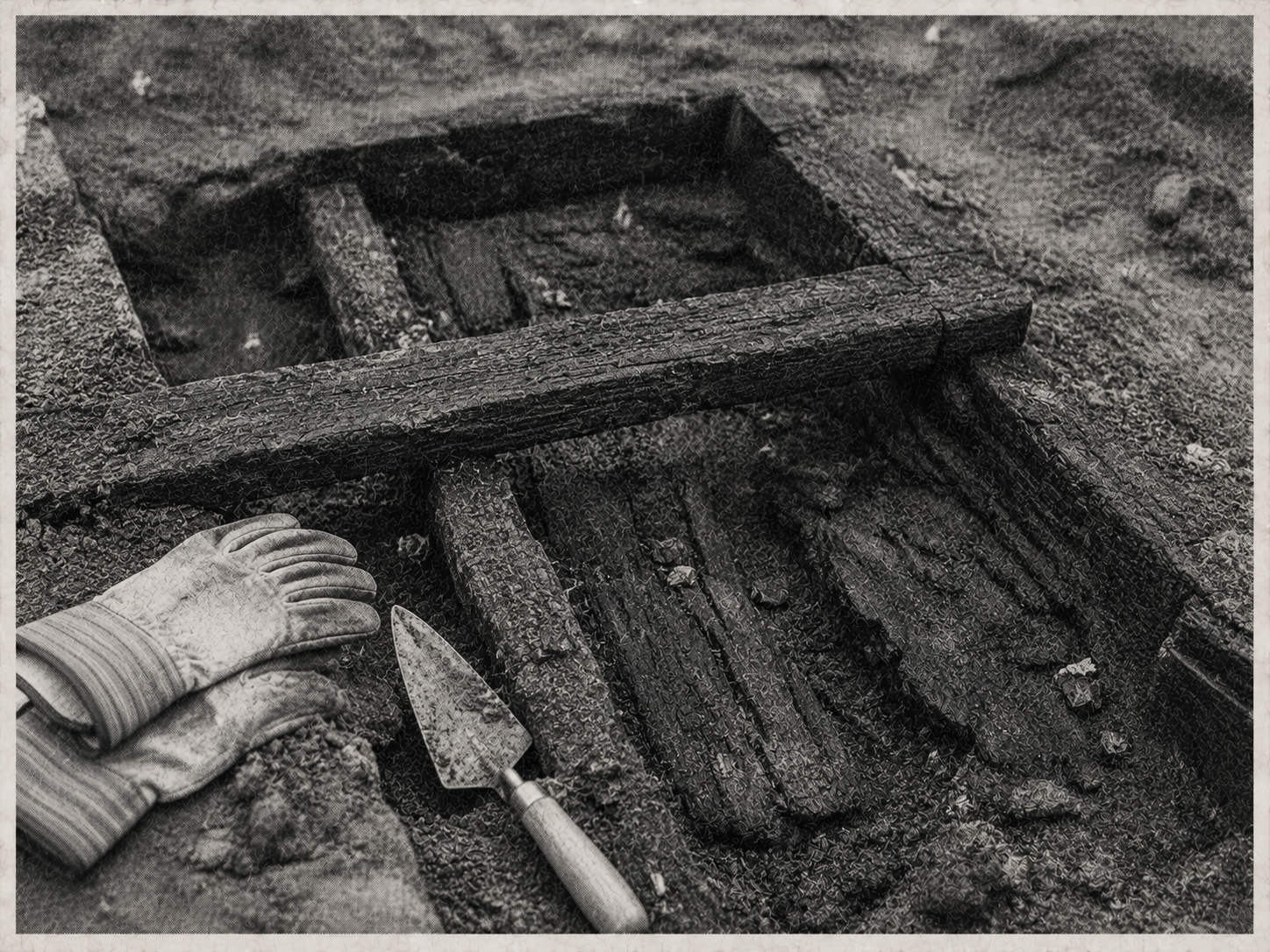
In the spring of last year, a camp maintenance crew clearing brush along the eastern edge of the grounds for a planned equipment shed struck, less than two feet down, a section of old, half-rotted timber too regular and too deliberately joined to be construction debris or fallen fence line. It took the better part of an afternoon to fully expose, a low, buried lattice of beams, charred along several edges in a pattern consistent, once someone finally thought to compare it against the old county fire report, with material that had burned and been buried rather than simply decayed in place.
Nobody on that crew had any reason to know what they were looking at. The camp's current keepers did, the moment word of the find reached them, and made the quiet, deliberate decision, consistent with every choice their predecessors had made across nearly seventy years of this record, to have the site carefully documented, gently reburied, and left undisturbed rather than excavated further. Some ground, Helen Mercer had written more than once in her final years, is better left to keep its own counsel.
It was, as far as the current keepers have been able to determine, the closest anyone had come to physically touching the original fairground's remains since the clearing crew of 1958 first abandoned their attempt to take down the bell tower.
It would not be the last such sign that year.
Through the following months, the small circle entrusted with the full archive began noticing, and carefully cross-referencing against each other, a cluster of smaller, more easily dismissed occurrences, the kind of thing that means nothing on its own, and starts to mean a great deal once enough of it accumulates in a short enough span of time.
A groundskeeper reported, twice within the same month, finding a section of perimeter fence near the eastern tree line unlatched and standing open at first light, despite having personally secured it the evening before, a detail that might, on its own, have simply meant a forgetful colleague or an unlatched gate, except that the same groundskeeper reported, on both mornings, an unusual stillness in that particular section of woods: no birdsong, no ordinary rustle of small animal movement, a silence he described, in terms that would have been entirely familiar to Otto Kessler's old retriever sixty-seven years before, as "not the kind of quiet that just happens on its own."
A counselor working late one evening in the equipment barn reported hearing, faintly and only for a handful of seconds, a few bars of music she couldn't place, tinny and old-fashioned, coming from somewhere she could never afterward pin down more precisely than "outside, but not from anywhere outside that made sense", music that stopped the moment she opened the door to check, leaving nothing behind it but the ordinary sound of wind in the tree line.
None of this, taken piece by piece, would have alarmed anyone who hadn't already spent decades learning exactly what to watch for. Taken together, cross-referenced against Helen's final entry, keep watching the field, especially the quiet years, and set against a silence that had by last year stretched to seventeen years exactly, the current keepers arrived, carefully and without any single dramatic moment of realization, at a conclusion none of them had wanted to reach.
The quiet years, they came to believe, were ending.
The decision that followed was not made lightly, and this account exists, in the specific and unusual form you are now holding, entirely because of it.
Every prior season of Richmond Survival Camp, since Helen Mercer's original 2016 conversation with Daniel Ruiz, had drawn on this legend only in its carefully sanitized form, atmosphere and flavor, a strong regional ghost story dressed up for whichever theme a given year's counselors happened to choose, never once, in nearly a decade of camp seasons, presented as anything more than fiction to the young adults who came through its programs.
The current keepers, weighing the signs of the past year against everything Helen and Walter had spent their lives documenting, made a different choice for 2026.
They could not, in good conscience, cancel the camp outright, not on the strength of a buried timber frame and an unlatched gate, not without a certainty neither the archive nor the keepers themselves actually possessed, and not, several of them have since said plainly, when doing so risked losing the one advantage nearly seventy years of careful vigilance had actually managed to build: a body of knowledge that no prior generation facing this thing had ever had the benefit of walking in with.
What they chose instead was closer, in spirit, to what Helen had always hoped this camp might someday become, if the waiting ever stopped being simply waiting. This year's theme, the fairground, the abandoned carnival, the horror at the heart of it all, was not selected at random, and it was not selected only for its atmosphere. It was selected because the current keepers came to believe that if this really was, at long last, the year the pattern finally closed the distance it had been narrowing for nearly seventy years, then every camper walking onto these grounds deserved a fuller accounting than any previous season's participants had ever been given.
Not the complete truth in every particular, this account has, throughout, preserved certain cautions Walter Nash first put in place in 1995 and that every keeper since has honored in turn. But enough. Enough to recognize a name, if it comes to that. Enough to understand why a bell matters, and why it was never rung, and what ringing it might actually mean. Enough, in short, to walk toward whatever this camp holds this year having heard the shape of it once already, in exactly the safe, deliberate form Helen always hoped a future generation might someday receive it in, rather than walking in blind, the way this whole town once did, on one beautiful October night in 1958, with absolutely no warning at all.
This is why you are reading this. This is what all of it, Walter's forty years, Helen's fifty-four, Daniel's torn scrap of paper on a platform in Colter's Crossing, seventy years of careful, patient, unglamorous keeping of watch, has, in the end, been for.
One further detail belongs in this record, discovered only weeks before this account was finalized for distribution, and included here because the current keepers agreed, without much debate, that nothing found this close to camp should be left out of what campers are given to read.
The county fair board, finalizing this year's vendor and attraction lineup for the annual autumn fair that Richmond Survival Camp's incoming session traditionally attends as part of its opening activities, confirmed to a keeper who inquired directly that a new attraction had been added to this year's roster in the final weeks before opening, a dark ride, arriving independently rather than through any of the fair's usual established vendors, with paperwork that a fair board member described, in a conversation this account will not further characterize beyond what was actually said, as "a little thin, though everything technically checked out well enough to approve it."
No company name appears anywhere on the permit beyond a signature the fair board could not later fully read back with any confidence. No prior operating history could be located for it anywhere the current keepers searched. It appears on this year's fair map simply as an unnamed dark ride, positioned at the fairground's edge, nearest the tree line, and it is scheduled to begin operation the same week Richmond Survival Camp's 2026 session begins.
The keepers do not know, as this account goes to print, precisely what that ride is, or precisely what it means for this to be arriving now, in this particular year, after seventeen years of exactly the silence Helen Mercer spent her final months insisting they never fully trust.
They have their suspicions. This account trusts you, having read this far, to have arrived at the same ones.