
Chapter Seven: The Book Walter Never Published
Walter Nash spent the last six years of his life writing a book he already knew, before he'd finished the first chapter, he would never let anyone publish.
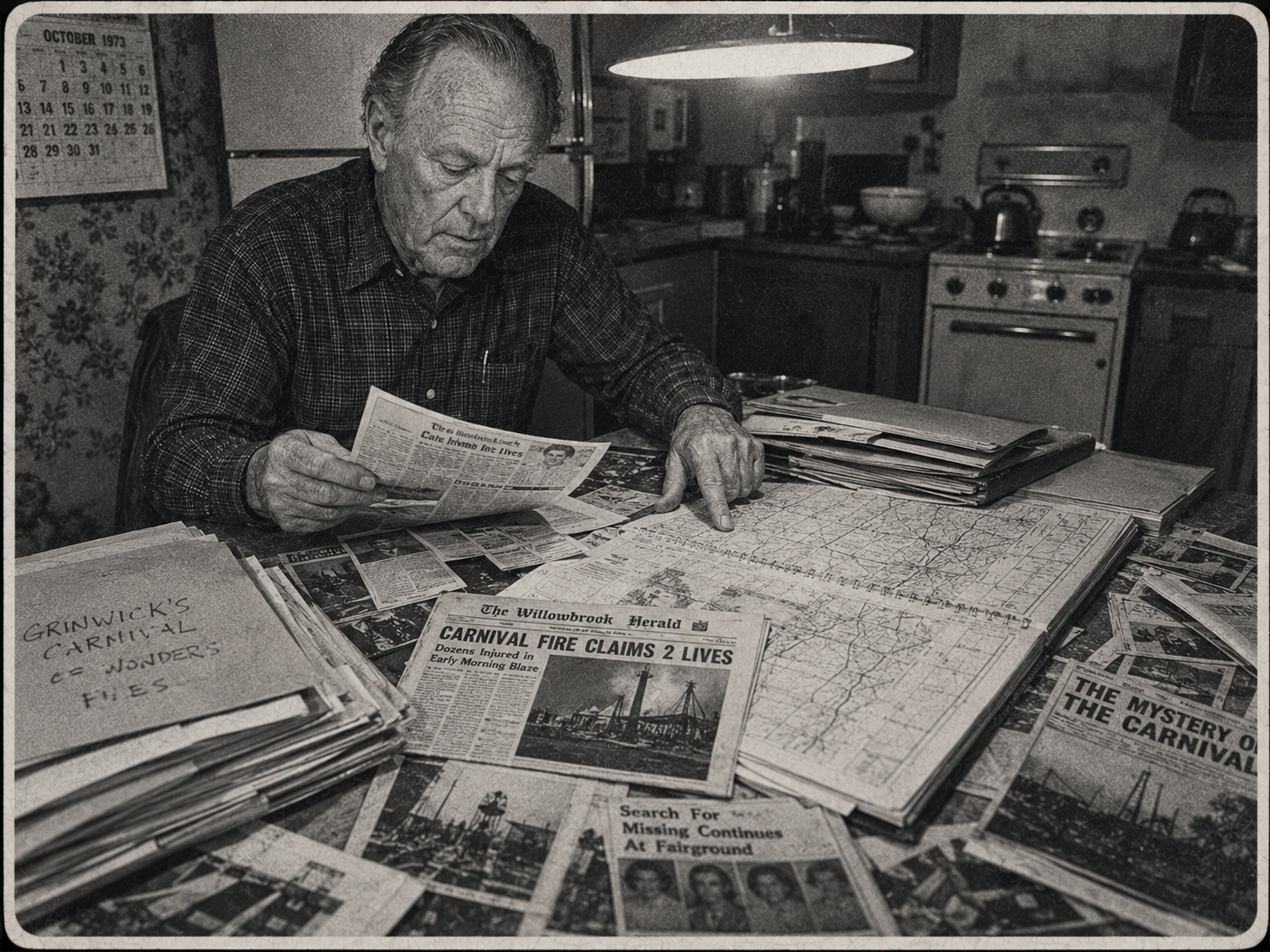
He began it in the winter of 1995, three years after Millhaven, at an age when most men who'd spent thirty-seven years chasing a single unfinished story might reasonably have decided to let it rest. Walter did not decide that. What he decided instead, he told Helen this plainly, over the kitchen table that had by then hosted a great many of their most difficult conversations, was that thirty-seven years of scattered notebooks, newspaper clippings, and a road atlas full of red pins was not, in the end, a form any single person could safely inherit whole. If something happened to him before the pattern finally resolved itself, whatever came after him, Helen, or whoever Helen eventually chose in turn, deserved a single coherent account, not a shoebox of fragments that would take another decade just to properly assemble.
So he wrote. Slowly, in longhand at first and later, at Helen's gentle insistence, typed up in the evenings on a secondhand typewriter she brought over from the library's own storage room. He called it, in the working title he never crossed out even once across six years of drafts, simply The Last Carnival: What I Believe I Know, and What I Am Only Afraid Of.
It ran, by the time he set down his pen for the final time, to just under three hundred pages. It has never been published. It has, in the decades since, been read by a very small number of people, Helen Mercer first, and then a short, carefully chosen line of successors after her, and now, in the particular and unusual form you are holding, by every Richmond camper who has ever agreed to carry this story into whatever week of camp waits for them.
The reasons Walter gave for never publishing it more widely are worth understanding, because they are the same reasons this account has never once, in the decades since, been offered to anyone who did not need it.
The first reason was the plainer one, and the one Walter himself led with whenever Helen asked him about it directly: he had no proof. Not the kind that survives an editor's scrutiny, or a skeptical reader's demand for something more solid than pattern and coincidence and one old man's road atlas. Every piece of it, taken alone, had an ordinary explanation available to anyone who wanted one badly enough. Runaways happened. Traveling shows sometimes struck their tents quickly and left before anyone thought to note the hour. Grief made people see and hear things in empty fields at night. Walter had spent nearly four decades convinced the pattern beneath all of it was real, and he knew, with the clear-eyed honesty of a man who had once been a working journalist, that conviction was not evidence, and that a book built on nothing sturdier than conviction would do far more damage to the truth than simply staying quiet ever could.
The second reason took him longer to arrive at, and it is the one Helen has always considered the more important of the two, the one that shaped not just whether the book would be published, but who, eventually, would be allowed to read it at all.
Walter had spent enough of his life, by then, thinking carefully about what he believed the Understage actually was, a term he adopted, late in his research, from an old carnival hand he'd interviewed in the early 1990s, a man who'd used it casually, almost without thinking, to describe the tangle of rigging, machinery, and hidden crawlspace that ran beneath any traveling show's main stage, the working guts of the production that no audience was ever meant to see. Walter borrowed the word for something considerably older and considerably less mechanical, and by the time he sat down to write his manuscript in 1995, it was the only name he used for it anywhere in his notes.
I don't believe, he wrote, in a passage Helen has since had copied into every later edition of this account, that the Understage is something that arrived with Gravely's Carnival, or was summoned by it, or was ever, in any simple sense, invited in. I believe it is older than any single show that has ever operated above it, and that carnivals, traveling ones especially, built new in a different field every few weeks, half real and half performance, full of painted faces promising a kind of joy that always, deliberately, sits one half-step short of true, are simply the shape of building it finds easiest to live beneath. It does not want blood. I want to be plain about that, because it would be easier, in some ways, to write about a thing that wanted blood; blood is a hunger people understand. What I believe it wants is a very particular kind of feeling, the exact, narrow overlap between delight and fear that a crowd produces when it is being frightened on purpose, by something it has paid to be frightened by, and is still, somehow, enjoying. An audience that is having fun being scared is, I believe, the single most valuable thing in the world to whatever lives under that ground, and a show that can reliably produce that feeling, night after night, is the only kind of tenant the Understage has ever wanted to keep.
It is this passage, more than any other in the manuscript, that explains why Walter chose to write his book at all, and why he refused, just as firmly, to ever let it become the kind of book a stranger might pick up for entertainment.
If I am right about any of this, he continued, a few pages later, then the worst thing I could possibly do with what I know is turn it into a good story. A widely read one. The kind that gets passed around at parties, that gets adapted, that draws its own crowd of people delighted to be a little frightened by something they've paid, in one form or another, for the privilege of enjoying. I have spent nearly forty years watching this thing feed on exactly that feeling in one small town after another. I will not spend whatever years I have left helping it find a bigger table.
This book is not for a general reader. It is for whoever comes after me and needs to know the shape of what they're watching for. If that is ever, someday, a wider group of people than I can presently imagine, if there is ever a reason this needs to be read by more than one careful keeper at a time, then I trust whoever makes that call to have thought as hard about it as I have, and to make very certain the people reading it are reading it to be ready, and not simply reading it to be entertained.
Helen Mercer, and every keeper after her, has taken that instruction seriously for over thirty years. It is the reason this account exists in the form it does now, not a published horror story sold to strangers, but a private record, handed deliberately and only to those who are actually walking toward the thing it describes.
The manuscript's middle chapters, the bulk of its nearly three hundred pages, cover ground this account has already walked through in its own way: the fire, the missing Ringmaster, Colby Springs, the slow, patient decade-by-decade tightening of the circle on Walter's road atlas. But it is in the manuscript's final section, written in the last two years of his life when his handwriting had grown noticeably less certain, that Walter allowed himself to say plainly what he had spent decades only circling.
I believe the young man who ran that show in 1958 made a bargain that night, in whatever brief window exists between watching everyone you love die and having nothing left to lose by trying anything at all. I do not believe he was given generous terms. I believe he traded the only thing that was still fully his to trade, not his life, which by every account he did not lose that night, but the last of whatever made him a person distinct from the show he ran, his own name included, in exchange for the show, and everyone in it, continuing rather than simply ending in that fire the way every ordinary tragedy is allowed to end.
I do not think this was a cruel bargain on his part. I think, God help him, it may have been the single kindest impulse of his entire life, offered in the one moment he had no time left to consider what it would actually cost the people he thought he was saving. Otto Kessler did not ask to keep pulling at wreckage forever. Loretta Voss did not ask to spend eternity warning people in riddles because a full sentence of truth is apparently more than whatever holds her now will allow. I do not believe any of them chose what they became. I believe one desperate young man chose it for all of them, in a single unbearable minute, and has spent every year since trying to convince himself, and everyone forced to watch him perform it, that the trade was worth what it cost.
I do not know his name. Nobody I have ever spoken to, across nearly forty years, has been able to give it to me. I have come to believe that this is not simply a gap in the record. I believe the bargain took his name specifically, that whatever he traded for, the price included the one thing that made him a particular person rather than a role, and that "Grinwick," when it finally surfaced in 1992, is not a name he chose so much as the only word that was left once everything else had been spent.
If there is a way to end this, and Loretta Voss told a woman I trust completely that there is, a bell, and someone meant to ring it, I do not believe ending it means destroying him. I do not think, after everything I have learned about who he was before that fire, that he would want to be destroyed, exactly, so much as finally, after however many decades it has been by the time someone reads this, allowed to stop.
Whoever you are, reading this, I am sorry it has fallen to you. I hope, whatever else is true, that you are not facing it alone.
Walter Nash died in the spring of 2001, at seventy-nine, quietly, at home, of causes that had nothing to do with any of this, the ordinary, unremarkable ending of an ordinary, remarkable life, exactly the kind of ending he had spent nearly forty years wishing for every single person the Understage had ever taken instead.
Helen Mercer delivered the eulogy herself, and said, near its close, a line that has since been copied into the front matter of every edition of this account that has followed:
Walter Nash spent the better part of his life keeping watch over something most of this town never knew was there to watch. He never once asked for thanks for it, and he would tell you, if he could, that he doesn't want any now. What he wanted, the only thing he ever really wanted, across nearly forty years of this, was for whoever came after him to be a little more ready than he was.
I intend to see that they are.
She was, by every account of the twenty-four years that followed, entirely true to her word.