
Chapter Thirteen: The Ride
This is the last chapter this account will offer you before you go, and it is, deliberately, the shortest.
Every keeper who has worked on this record, Walter first, then Helen, then the small circle who carried it forward into this year, has agreed on one final point of caution, and it is worth stating plainly before you read any further: nobody currently holding this archive knows what happens after the point where this chapter ends. That is not an oversight. It is the honest limit of seventy years of careful research, and this account has no intention of pretending otherwise now, in its final pages, after twelve chapters spent insisting on exactly that kind of honesty.
What follows is simply what is known. Where it stops, it stops because the knowing stops there too.
The county fair opens, this year, on schedule, the same modest, familiar affair it has been for as long as anyone in Richmond can remember, livestock judging, a midway of ordinary rides, the same handful of food vendors who set up every autumn without fail. Richmond Survival Camp's incoming session will attend, as it traditionally has, on its opening day, a last ordinary outing before the week's programming properly begins.
Near the fairground's eastern edge, close by the tree line, sits this year's addition: a dark ride, modestly sized and unremarkable in its exterior presentation beyond a hand-painted sign above its entrance reading NIGHTMARE NEVER CLOSES, and a single attendant, a barker, cheerful and insistent in the practiced way of anyone who has worked a midway for years, who will tell anyone who lingers near the entrance, with a warmth that several fairgoers have already described as slightly too warm, that they really ought to ride before the lights go out for the season.
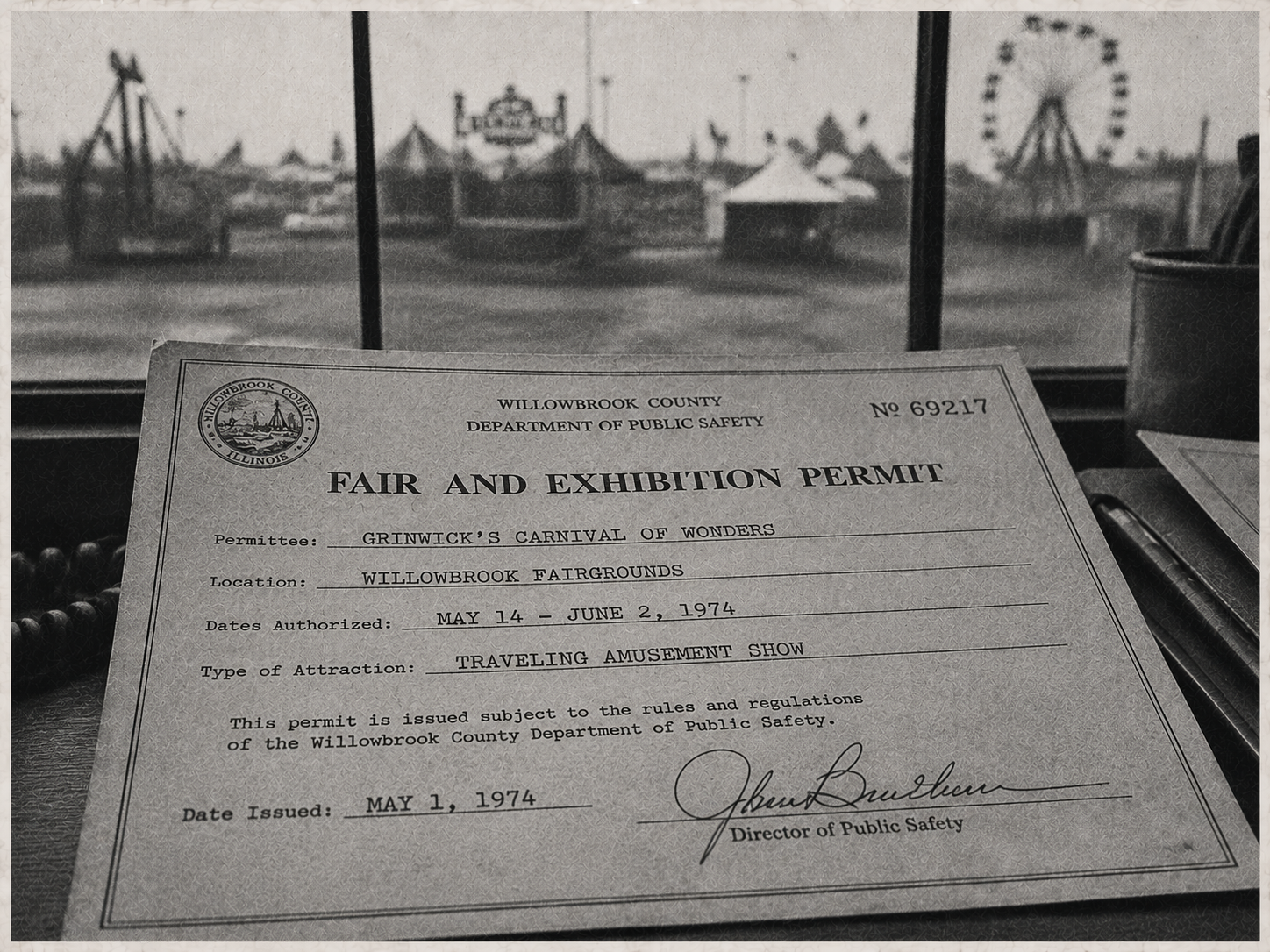
There is nothing, on the fair's official records, to indicate where the ride came from, who operates it, or how its permit was approved with a signature no one on the fair board has been able to read back with confidence. The current keepers of this archive have looked. They have found nothing beyond what Chapter Eleven has already told you.
What this account can tell you, because every keeper who has read this far has agreed it matters more than anything else in this final chapter, is this: the ride will very likely seem, for most of its length, exactly like what its sign promises. A dark ride. Cheap scares, corny narration, blacklight paint and animatronics on well-worn tracks, the kind of attraction every county fair has offered in one form or another for generations. It is not, in its opening minutes, meant to feel like anything more than that.
This account asks you to pay close attention anyway.
Watch for a moment when the ride runs longer than it reasonably should. Watch for animatronics that stop moving the way a machine moves, and start moving the way a person does. Watch for painted backdrops that stop looking painted. Watch, above everything else, for the moment, and every account this archive has ever gathered of a threshold like this one agrees there is always a moment, when you understand, with a certainty that has nothing to do with anything you can point to directly, that the ride is no longer taking you somewhere and back again.
It is only taking you somewhere.
There is very little else this account can honestly offer you.
It cannot tell you what waits on the other side of that threshold, beyond everything the previous twelve chapters have already prepared you to expect. It cannot tell you how the show will present itself this year, what shape the fairground will take, or which of its five bound performers you are most likely to encounter first. It cannot promise you the contract's fragments will be easy to find, or that the bell, once found, will be easy to reach. Seventy years of careful research has bought you a great deal, a name, a history, an understanding of what you are actually facing and why, a clear sense of what winning would even mean. It has not bought you a map of the fairground itself. That much, this account is certain, is something you will have to find on your own, the same way every camper who has ever walked into a season of Richmond Survival Camp has had to find their own way through whatever that year's grounds asked of them.
What this account can offer, in its final lines, is the same thing Walter Nash tried to offer in the closing pages of a manuscript he never let the world read, and the same thing Helen Mercer tried to offer in the last entry she ever wrote before her own watch finally ended.
You are not walking into this unprepared. You are not the first person this town has ever sent toward that fairground, and if there is any mercy at all in seventy years of grief finally amounting to something, you will not be the last person who needed to be.
Somewhere, in whatever this year's carnival has become, there is a bell that has been waiting since 1958 to finally be rung.
This account, and everyone who built it before you, hopes with everything it has that you'll be the ones to ring it.
End of the account.
Compiled and preserved by the keepers of the Richmond archive, on behalf of Walter Nash, Helen Mercer, and everyone this story was never able to save in time. Good luck. Watch for the bell.