
Chapter Three: What the Town Buried
Grief, in a town the size of Richmond, is not a private matter for very long. It moves through a place like that the way water moves through low ground, finding every seam, filling every space that will hold it, until there is no household left standing entirely dry.
The funerals took the better part of two weeks. Some families buried their dead within days; others waited, for reasons that had nothing to do with faith and everything to do with the plain, exhausting logistics of grief on that scale, a town's only funeral home suddenly asked to do the work of ten. The Richmond paper, which under ordinary circumstances ran to eight pages twice a week, printed a special edition that October that ran to twenty, most of it obituary, and even that, by the account of the young reporter tasked with compiling it, felt like it left things unsaid that needed saying.
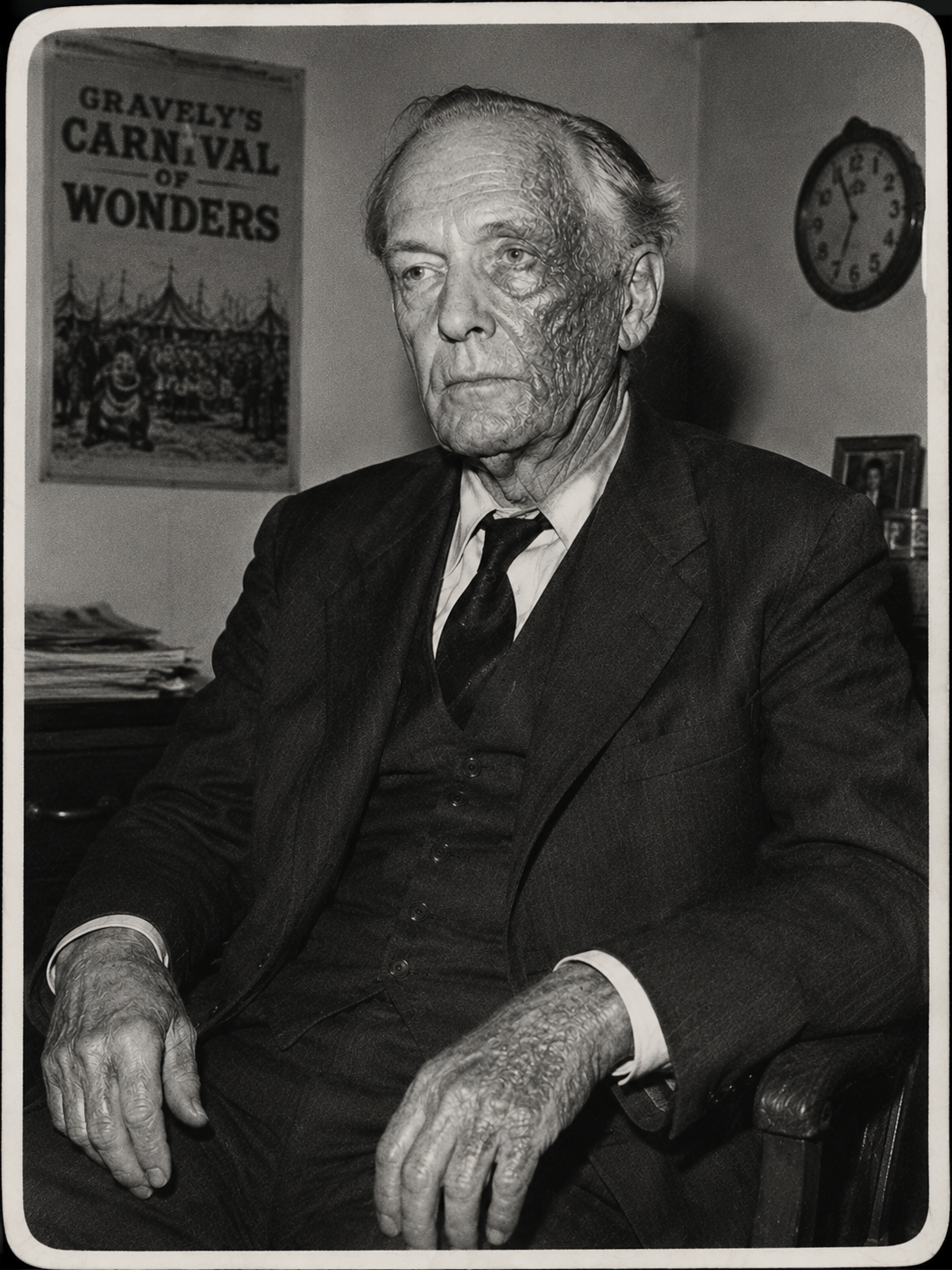
That reporter's name was Walter Nash, twenty-four years old that October, four months into his first real newspaper job, and entirely unprepared, as anyone would have been, for what he was about to spend the rest of his working life trying to understand.
Walter had been at the fire himself. Not as a reporter, he'd gone that night as a Richmond man first, the same as anyone else, taking his mother to see the Marchetti twins one more time before the season closed, the same way half the town had. He'd gotten her out early, in the first minute, through a stroke of luck he would spend decades quietly ashamed of calling luck at all, and then he'd done what a certain kind of young man does at twenty-four when the worst night of his hometown's history is happening in front of him: he'd gone looking for a way to be useful, and found, instead, a story he could never fully put down.
His first assignment in the fire's aftermath was straightforward enough: help compile the obituaries, get quotes from the fire company, chase down whatever official statement the county could be pressured into giving. It was the second assignment, the one nobody officially gave him, that would end up defining him.
Nobody could account for the Ringmaster.
It struck Walter, in a way it apparently did not strike very many other people in those exhausted first weeks, as a genuinely strange gap in an otherwise horrifically complete accounting. Every other person connected to that fire, audience, performer, or bystander, had, however grim the process, eventually been placed. Alive, in a hospital bed or a family home. Or dead, laid out under a headstone with a date on it. The Ringmaster alone occupied neither column. He simply was not anywhere, and in the weeks that followed, as Walter began, first idly, then with a focus that worried his own mother, asking around about him, he discovered an unsettling second fact layered underneath the first.
Almost nobody could tell him the man's actual name.
It seems impossible, in hindsight, that a performer so central to a show that had anchored a town's entire autumn for generations could have gone by nothing but a title in the memory of everyone who'd watched him. But Old Gravely's surviving business records, recovered, badly water-damaged, from the show's charred administrative wagon, listed him only as "Ringmaster" on every payroll ledger Walter could locate, a title rather than a person, the way a business might list "Manager" without ever bothering to record which manager. The show's other surviving hands, the handful who'd been on the road with the carnival but hadn't been present in Richmond that final night, remembered him fondly, extensively, and, every single one of them, independently, a detail Walter would note in his private files with something close to disbelief, could not produce his given name when directly asked.
He came up as a boy, one of them told Walter, an old roustabout named Frye who'd worked the show's rigging for over twenty years. Everybody just called him what everybody called him. I don't rightly know that I ever heard different. Strange thing to say about a man you worked twenty years alongside, isn't it.
Old Gravely himself, in the eleven years he lived after the fire, gave exactly one interview about that night, and gave it, pointedly, not to Walter but to a larger regional paper that came through looking for a bigger story than Richmond's local coverage could offer. He answered questions about the fire's likely cause with the weary, deflecting non-answers of a man who had clearly rehearsed them. He answered exactly one question about the Ringmaster, and the transcript of that single exchange survives, because Walter, furious at having been scooped on his own town's tragedy by an out-of-county paper, and unable to leave it alone, tracked down a copy and kept it for the rest of his life.
Question: And the young man who ran the show that final season, what became of him?
Gravely: He gave more to that show than any man ought to give to anything. I'd ask you to leave it there.
Question: Do you believe he's alive, Mr. Gravely?
Gravely: I couldn't rightly tell you what he is anymore. I'm not sure that's a question with an answer I'd want.
He gave no further comment on the subject, that day or any other, before his death eleven years later.
The Kessler pasture, Otto's family's own land, the ground the carnival had returned to every October for longer than living memory, became, in the months after the fire, a problem nobody in Richmond quite knew how to solve.
Otto's father, already an old man by then and now burying a son on top of everything else that acreage had cost him, wanted it gone from his life entirely. He had the burned wreckage of the big top cleared that winter, a slow, grim job, contracted out to men from two counties over because no local crew could be found willing to do it, and made it plain, to anyone who asked, that he had no further interest in what happened to the land afterward. It sat unused, unfarmed, and largely unvisited by choice, fenced along its road-facing edge with simple wire that was more gesture than barrier.
Almost everything from the wreckage was hauled off or scrapped that winter. Costumes, wagons, the show's few surviving banners, what could be salvaged was auctioned quietly to settle what remained of the show's debts, and what couldn't was simply disposed of, the way a town disposes of things it would rather stop looking at.
Two things were left standing.
The first was the bell tower. The clearing crew, by more than one account, made a genuine attempt to take it down that winter along with everything else, and gave up on it within the first day, for reasons that, when Walter eventually tracked down two of the men years later, they described with a discomfort that had clearly never fully faded. Ropes meant to pull the structure down came loose without explanation. A block-and-tackle rig, checked and re-checked, failed twice in ways the crew foreman couldn't account for afterward. One man, climbing to secure a line near the top, reported losing several minutes he couldn't remember, arriving at the top of the ladder, and then finding himself back on the ground with no memory of the climb down, his hands raw in a way that suggested he'd descended too fast, gripping too hard, though he had no recollection of feeling afraid.
The crew foreman, by the account he gave Walter decades later as an old man himself, made the call that any reasonable foreman would: We'll come back to it in the spring, once the ground's not frozen and we can bring proper equipment. Spring came. Nobody came back to it. By summer, it had simply become part of what was left, a fifteen-foot wooden tower standing alone in an otherwise empty field, weathering slowly, belonging to no one in particular, and somehow, without any single person deciding it, never again seriously discussed as something to be removed.
The second thing left standing was the ground itself, and this was the detail that would occupy the largest share of Walter Nash's private files over the years that followed.
Where the big top had stood, a roughly circular patch of the pasture, perhaps sixty feet across, nothing grew back correctly. Not nothing at all; that would at least have been a simple story, scorched earth taking its ordinary years to recover. What grew there instead, in the seasons that followed, grew wrong in ways nobody could quite agree on describing precisely, only that everyone who saw it agreed something was off. Grass came in patchy and pale, in rough concentric rings rather than the ordinary chaos of a recovering field. A local agricultural agent, called out at Otto's father's request the second summer after the fire, took soil samples and found nothing conclusive, and reportedly told the elder Kessler, off the record, that he'd rather not put anything in writing about a field that "felt like standing on a held breath." The phrase made its way, eventually, into one of Walter's notebooks with three separate exclamation points beside it. Walter Nash was not, by nature or training, a man given to exclamation points.
For the first several years, Richmond held a small memorial gathering at the pasture's edge each October, on the anniversary, never inside the fence, nobody suggested that, but close enough to matter. Attendance was strong the first year, understandably so; strong enough the second and third that the town briefly considered making it a permanent fixture, something closer to what the Last Carnival itself had once been.
By the fifth year, attendance had thinned considerably. By the tenth, it had become mostly the immediate families, Otto's widow, the Marchetti girls' mother, Loretta's few remaining relatives who still lived locally, a scattering of others, standing quietly at the fence line for perhaps twenty minutes before going home. This is not, it should be said clearly, a mark against Richmond. It is simply what grief does to a town over a decade: not vanish, but settle, moving from the center of daily life to somewhere further back, still present but no longer requiring daily attention. Richmond did what every town eventually does with its worst night. It kept living.
It was around the tenth anniversary that the first of the strange, small stories began circulating among Richmond's children, the kind of thing that gets passed kid to kid at recess and rarely reaches an adult's ears with any seriousness attached to it. Some local children had taken to daring each other, in the particular currency of childhood bravado, to go over the wire fence at night and touch the bell tower, a dare that, as far as any surviving account shows, was rarely actually completed, mostly talked about rather than attempted. But at least two separate children, interviewed decades later as adults by Walter Nash for his own private research, independently described the same detail from nights they claimed to have gotten close enough to the fence to hear something.
Calliope music. Faint, and from somewhere that could not possibly have had a calliope in it, a scrap of melody, familiar in a way that made the hair on the back of the neck rise before the conscious mind had finished placing why, and then, always, a single note that caught and hung a half-second too long before resolving.
The exact tune neither of them could ever fully name. But both of them, separately, without ever comparing notes with each other across the decades between their accounts, used the same word to describe it.
Unfinished.
Walter Nash never published a word of what he collected. He tried, twice, once in his thirties, once nearer sixty, drafts of a proper investigative piece that his own editor, a kind man who'd known Walter's whole career, gently talked him out of running both times, not because the paper doubted his facts, exactly, but because there was, in the end, no conclusion to any of it. No answer to hand a reader. Just a town's worst night, an unaccounted-for man, a field that grew wrong, and a bell nobody had rung in longer than most of the town could remember choosing not to.
He kept his files anyway. Boxes of them, eventually, handed down at his death to the Richmond Historical Society along with a note that survives, brief and characteristically understated for a man who had spent forty years on this single unanswered question:
I never found him. I stopped expecting to. What I found instead is that this town has spent longer forgetting that night than it ever spent living through it, and I don't believe, in my heart, that forgetting was ever really an option anyone gave us.
Somebody ought to keep watching the field, even after I can't.
- W.N.
Richmond, for the most part, did not keep watching. Life went on the way life does, and the pasture at the edge of town became, over the following decades, simply a known strange spot, the kind every town accumulates a few of, a place teenagers dared each other into, a story parents used to keep children from wandering too far after dark, more legend by then than living memory.
It would be nearly two decades before Richmond heard anything to suggest the story wasn't finished.
And when it finally did, the news would not come from the pasture at all.
It would come from another town entirely, three states away, in a newspaper clipping that made its way back to Richmond by the most ordinary means imaginable, tucked into a letter from a relative who had no earthly idea what she was describing, or why, when her own aunt back home finally read it, the woman's hands would not stop shaking for the better part of an hour.