
Chapter Two: The Night the Bell Didn't Ring
There is no surviving account of that night that agrees entirely with any other, and Richmond has, over the decades, made a kind of uneasy peace with that fact. Trauma does that to memory. It takes a single hour and breaks it into as many different hours as there were people standing in the crowd, and none of them wrong, exactly, just incomplete. Each survivor left holding one piece of a night none of them ever got to see whole.
What follows is the shape those pieces make when laid next to each other.
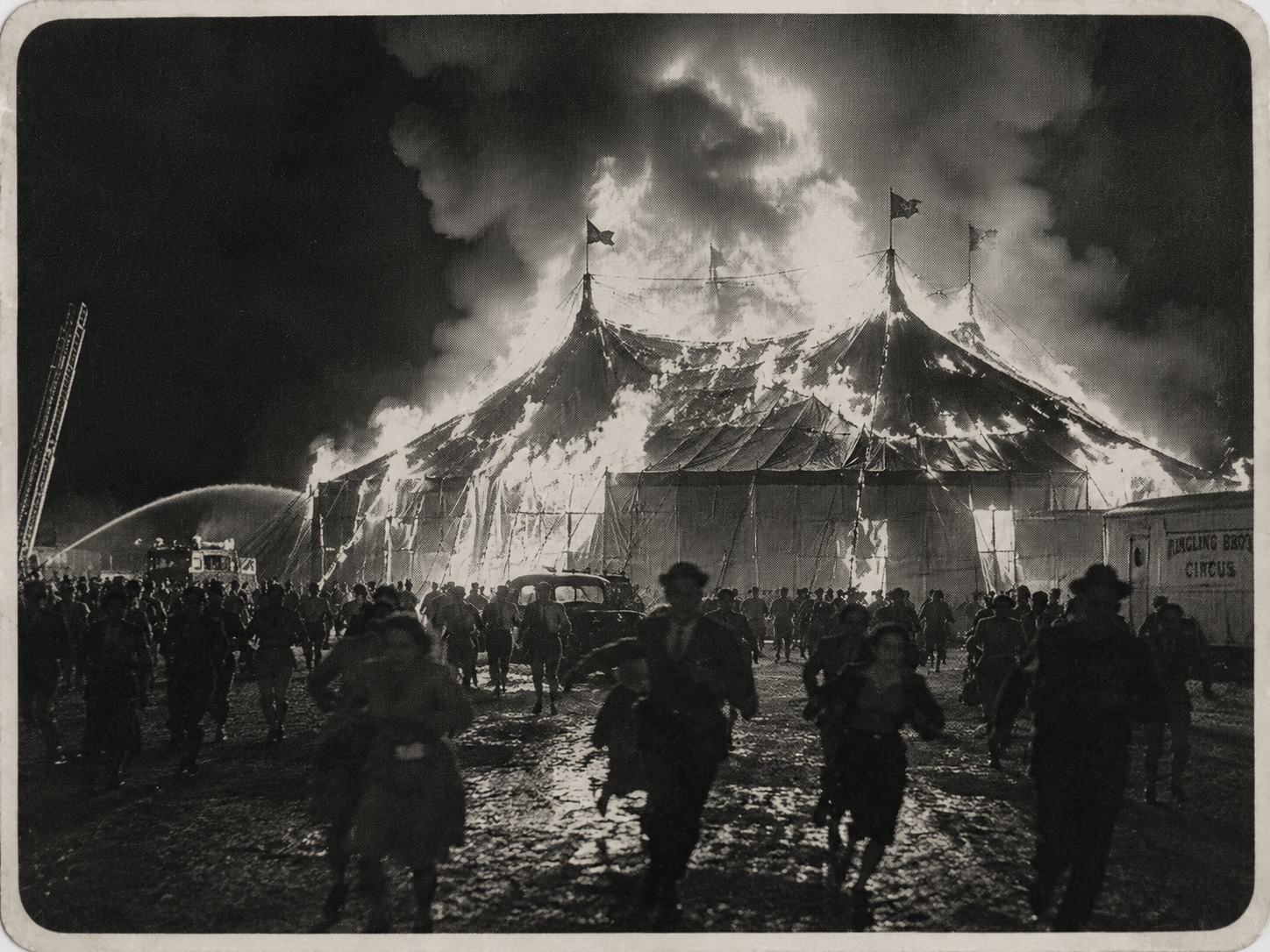
By eight o'clock, the fairground was as full as it had ever been. It was, by every account, a beautiful night for it: clear, cold enough for held breath to show, the kind of October dark that makes string lights look like something closer to stars. The big top was packed to its edges. Richmond had turned out in full, the way it always did for the final show, and the mood, in the hour before anything went wrong, was by every surviving account simply joyful. Nobody there that night has ever described feeling so much as a flicker of warning before it happened. Whatever wrongness had been creeping around the edges of that final week, the calliope's hitching notes, Otto's dog refusing the fence line, Loretta's uncharacteristic quiet, none of it, apparently, had followed the show into the tent itself.
The Ringmaster opened the evening the way he always did: no introduction, no fanfare, simply appearing at the center of the ring already mid-sentence, as though the show had been going on forever and the audience had simply arrived late to it. It was, longtime attendees would later recall, the best opening he had ever given. He was, that night, entirely himself: magnetic, funny, generous with the crowd in a way that made three hundred strangers feel, for a moment, like his personal guests.
The Marchetti twins performed second, as they always did: the tightrope act Richmond had come specifically to see, walking the wire in perfect mirrored step, arms linked at the finish the way the newspaper photograph had captured the autumn before. The applause for them, several witnesses recalled, went on long enough that Iris and Ivy had to be waved back out for a second bow, both of them grinning too widely to manage a proper curtsy.
Otto Kessler was there with his wife and both children, seated close enough to the ring that his youngest could see the twins' faces clearly, and would say for years afterward, long after she was old enough to understand what the night had actually meant, that Iris had winked at her during that second bow. It's a detail that survives specifically because it was, for that little girl, the last entirely happy thing she remembered about that night.
Charlie Pemberton was working the back aisle, selling the last of his balloons before the show's second half, glancing up now and then at the ring the way any seventeen-year-old would, half working and half simply watching, one week from the end of a job he'd genuinely, unexpectedly come to love.
Loretta Voss was not performing. Her act came, as it always did, in the smaller tent outside during intermission, but she had come into the big top anyway that night, standing at the very back near the entrance flap rather than in her tent, which several people noticed and nobody thought to ask her about until much later, when it no longer mattered why.
Pop was at his stall outside, as always, the coffee tin of butterscotch candies within easy reach, the smell of his grill carrying faintly even into the tent whenever the flap opened.
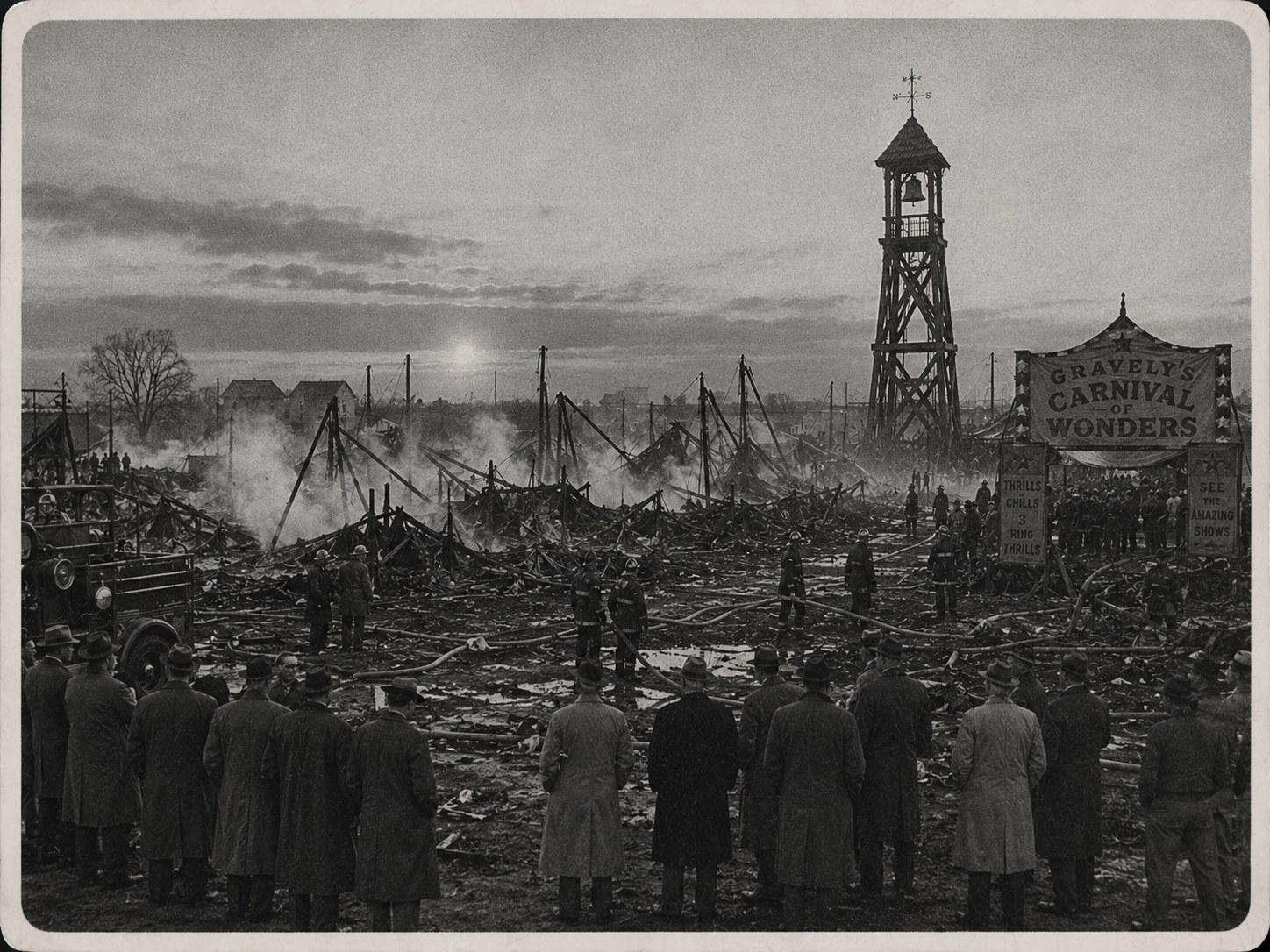
And somewhere above all of it, and this detail nobody disputes, because nobody could have missed it, hung the bell tower, its ladder now reachable only from the crowd side, exactly as the Ringmaster had asked, catching the light of the ring below it in a way that several witnesses would later describe as looking, for the first time all season, genuinely beautiful.
Nobody agrees on where the fire started.
Some say it began in the rigging above the ring, where the Marchetti twins' tightrope apparatus met the canvas ceiling in a tangle of cable and counterweight that had been rebuilt, patched, and rebuilt again over more seasons than anyone could account for. Others insist it began further back, near the lighting rig behind the main curtain, in wiring that had been jury-rigged season after season by hands that knew the show better than they knew anything about electricity. A handful of accounts, fewer but persistent enough over the decades that Richmond has never fully dismissed them, claim it didn't start anywhere at all in the ordinary sense. That it simply was, all at once, in more than one place, faster than any single spark could explain.
What everyone agrees on is how fast it moved.
The canvas overhead, decades of paint and weatherproofing baked into its fibers, went up in a way that canvas built for a traveling show should never have gone up: less like something catching fire and more like something that had simply been waiting for permission. The rigging above the ring, already weakened by whatever had begun there, gave way within what witnesses estimated, reasonably given what fear does to a person's sense of time, as under two minutes.
The center support beam came down first, directly through the space where the Marchetti twins had taken their final bow not ten minutes before.
They were not, thank whatever mercy the night had left in it, still standing there when it fell. But the rigging that came down with the beam tangled the exits nearest the ring, and it was there, in the panic of three hundred people trying to move at once through space that had, in the space of a breath, become half its previous size, that the worst of the night happened.
Iris and Ivy Marchetti did not run for the exits, when they might, by several accounts, have had the few extra seconds needed to make it. What survives instead, from more than one witness, independently, in accounts given decades apart to people who had no way of comparing notes, is that the girls turned back toward the ring, toward the still-full seats behind them, and kept performing. Not the tightrope act. Something smaller, quicker, closer to the ground, arm in arm the way they always were, guiding, gesturing, making themselves loud and visible and watchable in the exact way eleven years of training had built into them, holding just enough of the panicking crowd's attention just long enough to keep a stampede from becoming something even worse. One witness, a woman who would have been about their own age that night, described it plainly, decades later, without dramatics: "They were still smiling. I don't think either of them knew how not to."
Neither girl made it out.
Otto Kessler got his wife and both children clear within the first minute; his own dockworker's strength making short, brutal work of a section of collapsed bench that had trapped three other families behind it, and then, having done what any father would consider his job finished, went back in.
He is remembered, by nearly every survivor who saw any of it, as a wall of a man moving in the wrong direction through a crowd that was entirely moving in the other one. He pulled at least six people clear by the accounts that survive, possibly more that were never separately recorded, working his way steadily back toward the center of the collapse, toward the second support beam, which by then had begun to lean at an angle that anyone with sense would have called unsurvivable.
He was under it when it came the rest of the way down, still braced against it, still pushing, having apparently believed, which several witnesses insist was exactly the kind of belief Otto Kessler was built out of, that if he simply held on a moment longer, one more person could get past him and out.
His own children, safe outside by then in their mother's arms, were too young to understand what had happened until years later. His wife never remarried, and kept, for the rest of her life, a single photograph from that final season: Otto at the fence line of his own family's old pasture, laughing at something out of frame, the fairground lit up gold behind him.
Loretta Voss did not try to leave through the main exit at all.
She had known. This is the detail Richmond has turned over more than any other in the retellings that survive: she had known something was wrong before the fire ever started. Whatever gift she genuinely had, or genuinely believed she had, had been sounding some private alarm in her for days, and on that final night, standing at the back of the tent rather than in her own fortune-telling booth, she had apparently placed herself as close as she could manage to the side exit, a smaller flap at the tent's rear, rarely used by the audience, but functional, and in a real emergency, exactly the kind of second route that could have meant the difference for dozens of people.
Except that flap had been sealed, for reasons nobody was ever able to determine. A set-dressing decision, a scenic backdrop erected against it that final week to frame a new photo-opportunity display, an oversight, a coincidence; take your pick of explanations offered in the years since. Not locked. Simply painted over, the canvas backdrop tacked directly across the seam of the exit itself, indistinguishable in the low light from the rest of the tent wall unless you already knew exactly where to look.
Loretta knew exactly where to look. She spent, by the account of the two people who survived near enough to her to describe it afterward, nearly a full minute tearing at the painted canvas with her bare hands and screaming for people to come to her, to this way out, this way, here, and several people did reach her, and did get through, in the last handful of seconds before the smoke in that corner of the tent became something no one could breathe through and continue tearing at anything at all.
She did not make it through herself. The two survivors who owed her that exit have never, in any account on record, described her as anything other than the reason they lived.
Charlie Pemberton was caught in the stampede near the main gate. He was seventeen years old, one week from the end of his first season, still holding, several witnesses noted with a specific kind of horror reserved for details too small and human to be anything but true, a half-sold bundle of balloons that he never let go of even as the crowd behind him surged.
He was not a large young man. He had no training for what that crowd became in its final desperate seconds toward an exit gate that had not been built to move three hundred panicked people through at once. What accounts survive of his final moments are, mercifully, the least detailed of anyone's, not because nobody saw, but because the people who did have, without exception, declined across sixty-some years to describe it further than saying he went down early, near the front, and that the crowd behind him did not stop.
He was found near the gate the following morning. His family's grief, three streets from the fairground, was the kind Richmond still speaks of carefully, even now.
Franklin Pope was outside when the fire began. He was safely clear of the tent entirely, by every reasonable measure of that night's chaos, a fact that several people who loved him have spent decades wishing had simply been enough.
It was not enough, because Pop did not stay clear of it.
He went in. Twice, by two separate accounts, possibly a third time that nobody survived to confirm. Both confirmed trips were for children: a boy of about eight found disoriented near the collapsed benches, and a cluster of three girls, cousins visiting from out of county for the show, who had become separated from every adult they knew in the first chaotic seconds of the collapse. Pop got all four of them out, delivered personally into whatever waiting arms he could find at the gate, the coffee-tin, butterscotch-candy calm of him apparently entirely undisturbed even as everything around him was not.
It was on his third trip in. Accounts here grow thin, understandably, given how few people remained inside that fire by that point to witness anything at all, that the smoke that had claimed Loretta Voss's corner of the tent found him too.
He is remembered, in nearly every account that survives, less for how he died than for the plain, steady fact of what he did with every minute he had left once he understood the fire wasn't going to spare anyone who stayed. Several people who owe him their childhoods have, in the decades since, named their own children after him.
By the time the flames were finally beaten back by Richmond's volunteer fire company, arriving faster than anyone had any right to expect for a town that size, working through most of the night, the big top was a blackened, skeletal ruin, and the fairground that had, twelve hours earlier, been the most joyful place in the county, had become something the town would spend the next sixty-some years trying, and failing, to fully put words to.
The final count of the dead, when it was finally settled in the days that followed, numbered in the dozens, performers and townsfolk both, the show's own family and Richmond's intermingled in a grief so total that for years afterward the town avoided, by unspoken agreement, drawing too sharp a distinction between the two.
Old Gravely was found alive, badly burned, pulled from the wreckage near what had been the performers' entrance, and would live another eleven years, though by every account from those years, never again as anything more than a shadow of the man who had run that show. He never spoke publicly, in all that time, of what he had seen in the tent's final minutes. He is buried in Richmond's own cemetery, a detail the town has always found strange and never quite discussed, given he was not, by any measure but the last one, a Richmond man.
The bell tower, remarkably, was one of the only structures on the fairground left standing.
Nobody rang it.
There was, in the exhausted, grief-shattered hours after the fire was finally out, no ceremony left in anyone for that kind of gesture. By the time cooler heads might have considered it appropriate anyway, in the days and weeks that followed, the town realized there was no one left who held the authority to call for it. Old Gravely was in no state to give the order. The show's other senior performers were dead, or scattered, or too shattered themselves to be found.
And the young Ringmaster, the boy who had opened that night's show already mid-sentence, who had asked, that very afternoon, for a better sightline to a bell tower that would never again be used for its intended purpose, was never found at all.
Not among the dead, whose remains, however difficult the identifications, were eventually all accounted for.
Not among the survivors, none of whom, in sixty-some years of asking, has ever claimed to have seen him after the fire began.
He was simply gone, in the plainest and least satisfying sense of the word, as though the fire that took nearly everyone else the show had ever loved had, for him alone, made some other arrangement entirely.
Richmond would not properly understand, for a very long time, exactly how right that impression was.