
Chapter Six: 1992
Helen Mercer kept the watch the way she kept everything else in her professional life: methodically, without fuss, and with a thoroughness that would have made Walter Nash proud if he'd ever fully understood the scope of what she'd built out of the boxes he handed her in 1988. She subscribed, under the library's own name so as not to draw questions, to regional papers from every county within a day's drive of Richmond. She read the community events listings the way other people read the obituaries, carefully, completely, every single week, watching for one particular combination of words she hoped, every time, not to find.
She found it on a Tuesday in September of 1992, in a four-line notice buried on the community page of a paper from a town called Millhaven, forty miles east of Richmond, close enough that a fair number of Richmond families had cousins there, close enough that the county fair schedules sometimes overlapped and neighbors compared notes on which one had the better livestock judging that year.
GRINWICK'S CARNIVAL OF WONDERS, the notice read, in the same looping promotional script Walter's collection of old handbills had preserved from decades before. One Week Only, Millhaven Fairgrounds. Closing performance Saturday the 26th: THE LAST CARNIVAL OF THE SEASON. All welcome.
Helen read it four times before she trusted herself to stand up from her desk.
It was, as far as either she or Walter had ever been able to determine, the first time the name had changed. Every prior instance she and Walter had documented, Richmond in 1958, Colby Springs in 1975, the older, thinner records reaching back before that, had advertised under the same name the show had carried, presumably, for generations: Gravely's. This was the first appearance of Grinwick anywhere in either of their files, and Helen did not need Walter's decades of research to understand, on some instinctive level, exactly what the change meant. The Gravely name had finally, fully, run out of anyone left to claim it. What remained had simply taken the show as its own.
She drove to Walter's house that same evening. He was seventy years old that autumn, slower than he'd been even a few years before, but his mind, when she laid the clipping in front of him at his own kitchen table, sharpened in a way she hadn't seen from him in years.
Forty miles, he said, after a long silence, tapping the notice once with a finger that wasn't quite steady. Colby Springs was better than three hundred. This is forty, Helen.
He didn't need to finish the thought. She was already reaching for her coat.
Helen went to Millhaven twice that week, once on the Wednesday, to see the show for herself under the reasonable cover of an ordinary fairgoer, and once, four days later, for the closing night she had spent every hour in between trying, quietly and without much success, to talk herself out of attending.
The Wednesday visit gave her, by her own later account, more direct confirmation of Walter's decades of secondhand research than either of them had ever expected to receive in a single evening. The show was, exactly as every prior witness had described it across every prior decade, genuinely wonderful to watch, a fact Helen found, if anything, more disturbing than she had anticipated, having spent four years steeped in Walter's files without ever once being warned how easy it would be to simply enjoy herself, standing in that crowd.
Two young acrobat girls performed a tightrope act that drew gasps and sustained applause from a crowd that had no idea it was watching something sixty-some years old wearing an eleven-year-old's face. A vast, silent strongman worked the high-striker booth, drawing a small crowd of teenage boys daring each other to try their luck against a machine none of them could budge past its halfway mark. A boy, younger than Helen had expected, younger than she found she could comfortably watch for very long, sold balloons near the main gate without once, in the hour she observed him, speaking a single word to any customer. A heavyset man ran the food stalls with an easy, grandfatherly warmth that made Helen's chest ache in a way she hadn't anticipated and didn't fully understand until she remembered, with a small cold jolt, exactly whose description that matched in Walter's files.
She found the fortune teller's tent on her way back toward the gate, and stood outside it for a long moment before she let herself go in, telling herself the whole time that she was doing nothing more than confirming a detail for the record.
Loretta Voss, and Helen would never, for the rest of her life, refer to the woman in that tent by any other name, whatever the show's programs might have called her, looked, by every physical measure, exactly as she must have looked the night she died. Not aged a single visible day. Warm-eyed, in a way that made the whole encounter harder rather than easier. She took Helen's hand across the small table without being asked, the way, presumably, she had taken thousands of hands before it across thousands of nights just like this one, and turned over a single card, and went very still.
You already know the ending, Loretta said, quietly, in a voice that carried none of the practiced showmanship Helen had expected and every bit of the plain, unhurried sincerity of a woman speaking to someone she recognized. That's rare. Most people who sit here don't want to.
Helen, her own voice unsteady, asked the only question she'd come prepared to ask. Can it be stopped?
Loretta's expression didn't change, exactly, but something behind it seemed to press forward, straining against whatever kept her voice as measured as it was. Not from where you're standing tonight. Not this year. But you're keeping something, aren't you. Somewhere safe. Keep keeping it. Her grip on Helen's hand tightened, once, hard enough to hurt. When the whole story's finally written down, all of it, every piece, there's a bell. Find whoever's meant to ring it, when the time comes. It won't be you. But you'll know them when you see them.
She let go of Helen's hand as abruptly as she'd taken it, and smiled the same warm, professional smile she must have given every other customer that week, and said, in a voice that had gone bright and hollow and entirely unlike the one that had spoken a moment before, That'll be a dollar, dear. Enjoy the rest of the show.
Helen left the tent shaking badly enough that she sat in her car in the Millhaven fairground parking lot for the better part of twenty minutes before she trusted herself to drive.
She did not, in the end, manage to save anyone.
She tried. This matters enough to the record that Helen herself insisted, decades later, that it be included plainly whenever the story was told, that she had not simply watched and documented, the way Walter's own research, however thorough, had largely amounted to. She had spent the four days between her two visits attempting, with increasing desperation and decreasing success, to warn people away from Saturday's closing show, a letter to the Millhaven paper's editor that went unpublished, a call to the county sheriff's office that earned her a polite, patronizing assurance that the department was aware of the traveling show and had no concerns about it, a handful of direct, awkward conversations with strangers at a Millhaven diner that ended, every time, in the particular kind of embarrassed silence reserved for a woman who has just said something that sounds, from the outside, unmistakably unwell.
Nobody in Millhaven had a Walter Nash. Nobody there had spent three decades quietly building a case. Helen had four days, a stranger's town, and a story that sounded, however true, exactly like the kind of story no reasonable person is built to believe on a single hearing.
She did manage one small thing. A young couple she fell into conversation with outside the fairground gate on Saturday evening, new parents, their infant daughter asleep against the father's shoulder, mentioned, in passing, that they'd debated all week whether the closing show would be too much excitement for a baby that young, and Helen, seizing the opening with more force than the moment strictly called for, told them, plainly, that she thought they should trust that instinct. That she'd heard some concerning things about crowd safety at the fairground that week. That it wasn't worth the risk, not with a child so young.
They went home instead. Helen never learned their names, and has said, in every account she ever gave of that night, that she has thought of that unnamed sleeping infant more often across the following decades than she has been able to fully explain to anyone who wasn't there.
Everyone else who attended Saturday's closing show attended it exactly as Millhaven's own history would eventually, reluctantly, record: four residents unaccounted for by the following Tuesday, a fairground struck overnight without a trace, and a county sheriff's department that closed the matter, within a month, in language nearly identical to the language a different sheriff's department had used seventeen years before, three hundred miles away, about a matter nobody there had ever thought to connect to it.
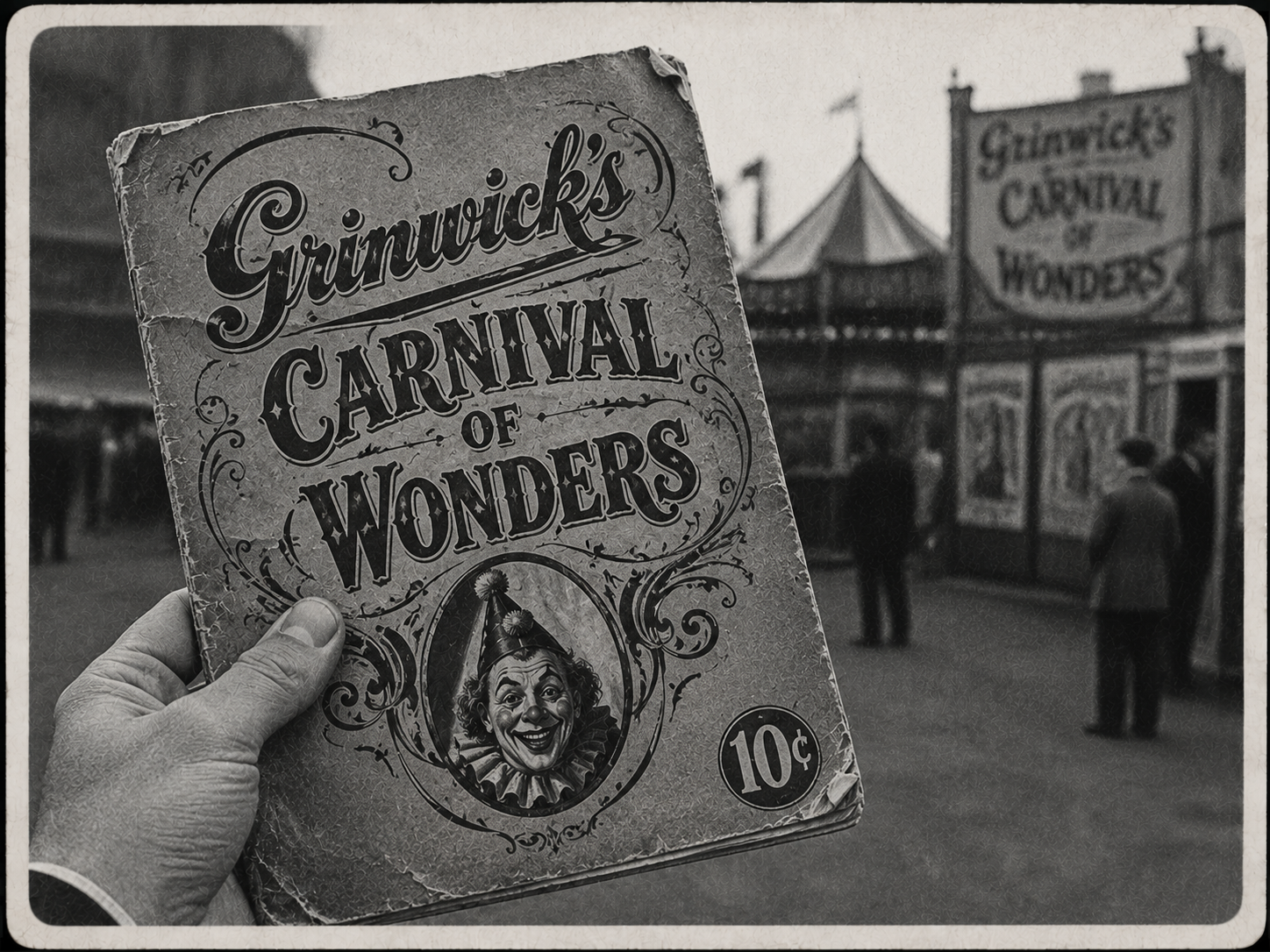
Helen brought the confirmation back to Walter the following week, the Millhaven paper's own thin follow-up coverage, her own handwritten account of the fortune teller's tent, a program she'd kept from her Wednesday visit with Grinwick's Carnival of Wonders printed across its cover in that same looping gold script the show had used, apparently, for generations, under whatever name happened to be true that year.
They sat together at Walter's kitchen table, the same table where he'd once shown her the photograph of Otto Kessler laughing at the fence line of his own family's field, and updated the road atlas together, a fourth red pin, placed with a steadiness in Helen's hand that she did not entirely feel, forty miles from the circle Walter had drawn around Richmond nearly a decade before.
It was, by a wide margin, the closest pin on the map.
Walter looked at it for a long time before he spoke.
Seventeen years put it here, he said finally. Seventeen more puts it, where, Helen? You've got a steadier hand at the arithmetic than I do these days.
Helen didn't need to do the arithmetic. She had already done it, more than once, in the days since Millhaven, in the particular way a person does math they are afraid of finishing.
2009, she said.
Neither of them said the rest of it aloud that evening, the plainer, harder question sitting underneath the date, the one about which direction on the map that next pin was likely to land. But Helen kept the program from Grinwick's Carnival of Wonders in the same archive box as everything else Walter had entrusted to her, and added, in her own careful hand, a note on the inside of the box lid that would remain there, undisturbed, for the better part of the next thirty-four years:
It has a name again. I don't think that's a comfort. I think it means there's less and less of the man left underneath it every time it comes around, and more and more of whatever's actually running the show.
Whoever reads this after me, Loretta Voss told me there's a bell, and someone meant to ring it, and that I'd know them when I saw them. I never did see them, in all my years of watching. I hope that means it simply wasn't my turn.
I hope, more than that, it means there's still time before it's anyone's turn at all.